
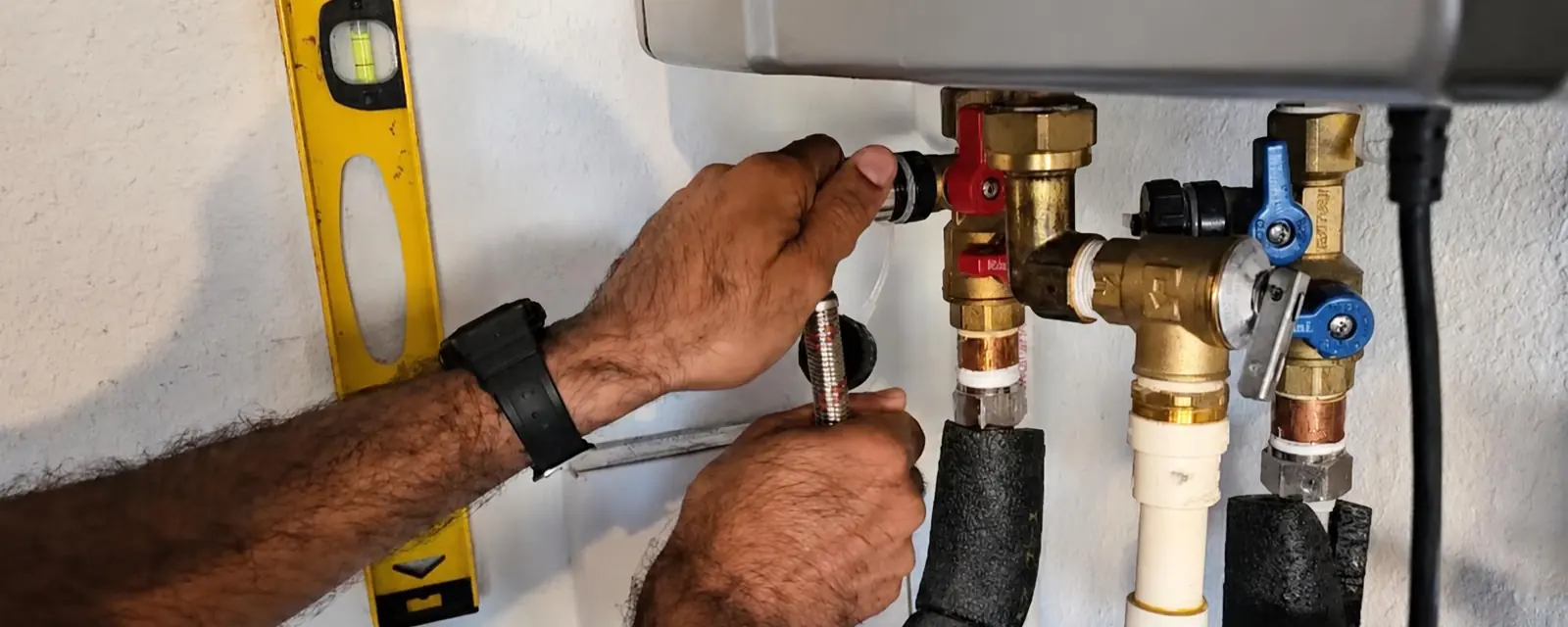
A condensing tankless water heater has a second heat exchanger that pulls heat out of the exhaust gas before it leaves the house. The exhaust cools enough that water vapor turns to liquid, which is why these units need a drain for acidic condensate and can vent through plastic pipe.
The payoff is higher efficiency than a non-condensing tankless unit, usually shown as an efficiency rating of about 90 percent or better on the label. The tradeoff is a more involved installation and a maintenance task that hard water makes more important.
This guide covers venting, the condensate line, the neutralizer, gas supply and upkeep. For the basics of tankless models, see our page on tankless water heaters.
Westminster's water averages roughly 14.7 grains per gallon of hardness, with a range of 138 to 413 mg/L across the system. That variation means scale buildup differs between homes, so flush on a schedule instead of waiting for an error code, and consider a softener if you see crust on your faucets.
What condensing actually means
A conventional gas heater sends hot exhaust up a metal flue. A condensing heater captures much of that heat first, so the exhaust leaves cool and wet. That leftover moisture is the condensate.
The condensate is mildly acidic, often in the range of vinegar to weak lemon juice. It is not dangerous in small amounts, but it can eat metal drains and damage concrete over time, so it must be routed and treated correctly.
| Feature | Condensing | Non-condensing |
|---|---|---|
| Exhaust temperature | Cool, produces liquid condensate | Hot, vents as gas |
| Vent material | Approved plastic such as PVC or CPVC, per the maker | Stainless steel vent pipe |
| Condensate drain | Required | Not needed |
| Efficiency | Higher | Lower |
| Install cost | Higher up front | Lower up front |
PVC venting rules you should know
Condensing units can use plastic vent pipe, which is easier to run through walls and attic spaces than stainless steel. The manufacturer's manual dictates the exact pipe type, maximum length and number of elbows, and those limits are not suggestions.
Exhaust and intake terminations must stay a safe distance from windows, doors and other openings. A poorly placed vent can push exhaust back into the house. Ask your installer to show you where the termination sits and why it was chosen.
Venting questions for your installer
- Which vent material does the manual specify
- How long is the run and how many elbows
- Where does the exhaust terminate outside
- Does the unit draw air from outside or inside
- Is the vent pitched so condensate flows back to the unit
The condensate drain and neutralizer
A condensing heater produces a steady trickle of condensate. The line must slope downhill to a drain, and it should never dip into a trap that can freeze, clog or hold acid against a fitting. A small floor drain, laundry standpipe or dedicated drain connection usually works.
A neutralizer cartridge is a small canister of limestone chips that raises the pH of the condensate before it goes down the drain. Many installers add one, and some local requirements call for it. Ask the City Building Division at (714) 548-3254 what applies here.
The chips wear down over time and should be checked at least once a year. A spent cartridge sends acidic water down the drain and can mean the unit has been quietly doing damage for months.
Gas line size and gas safety
A tankless heater burns a lot of gas in a short burst. Most homes with a tank heater have a gas pipe that is too small for the new demand, and an undersized line causes error codes, weak flame and lukewarm water at the tap.
Gas work and gas pipe sizing should be done by a licensed professional. If you smell gas at any time, leave the house, do not use switches, call from outside or a neighbor's home, call 911 if anyone is in danger, and phone the SoCalGas emergency line at 1-800-427-2200 if SoCalGas is your provider. Do not use light switches or lighters.
Hard Westminster water and scale on the heat exchanger
Westminster's 2024 Water Quality Report lists average total hardness at 252 mg/L, roughly 14.7 grains per gallon. Water that hard leaves calcium and magnesium on hot metal surfaces. A tankless heat exchanger has narrow passages, so scale builds there quickly.
The result is reduced flow, rising exhaust temperature, error codes and, eventually, a failed exchanger. A yearly descale flush is the standard fix. A water softener installed upstream cuts scale at its source and protects the rest of your plumbing too.
- 1
Turn off power and gas
Shut the unit off and let it cool first.
- 2
Close service valves
Isolate the heater from the house plumbing.
- 3
Circulate descaler
Pump a mild acid solution through the exchanger for the time the manual lists.
- 4
Rinse and restart
Flush with clean water, reopen valves and test the unit.
Isolation valves make yearly service easy
Isolation valves with built-in ports allow a flush without cutting pipe. If your installer left them out, ask for them at installation. They are cheap compared with the labor of adding them later.
Also clean the inlet water filter screen when you flush. A clogged screen starves the heater of flow and looks a lot like a failing unit. If the heater shows persistent error codes after a flush, see our water heater repair page.
- Flush once a year in hard water areas
- Check and clean the inlet screen
- Inspect the neutralizer cartridge
- Watch the vent and condensate line for leaks
- Keep a record of dates so you remember next time
Common error codes and what to try first
Every maker uses different codes, so the manual is your guide. Still, most codes fall into a few families: ignition problems, flow problems, venting problems and scale problems.
Before calling, check that the gas valve is open, the unit has power and the hot tap is fully open. Then clean the inlet screen. If the code returns, write it down and note when it happens, since a pattern helps a plumber diagnose faster. Never bypass a safety sensor to keep the unit running.
| Problem family | Common sign | First thing to try |
|---|---|---|
| Ignition | Unit clicks but never lights | Check the gas valve and supply |
| Flow | Cold water sandwich or lukewarm water | Clean the inlet screen, open the tap fully |
| Venting | Shutdown after a short run | Look for blocked or loose vent pipe |
| Scale | Rising temperature errors, low flow | Schedule a descale flush |
Is a condensing unit worth the extra cost
A condensing model often costs more to buy and install than a non-condensing one, and the savings arrive slowly through lower gas bills. Households that use a lot of hot water recover that difference faster than small households.
Cost varies widely with venting distance, gas line work and the drain route, so it is best to compare the full scope rather than just the unit price. We give a clear price before work starts. Our Garden Grove neighbors and Westminster customers are served from the same 24/7 phone line, and our service area list shows where we work.
According to the City of Westminster's 2024 Water Quality Report, hardness averages 252 mg/L, so plan on regular flushing. Installation follows the California Plumbing Code (Title 24, Part 5) and the maker's instructions.
Condensing tankless questions from Westminster homeowners
Does a condensing tankless heater need a drain?
Yes. The exhaust turns to liquid and must drain away. The line should slope downhill and usually passes through a neutralizer before it reaches a drain.
Can I vent a condensing unit with PVC?
Often yes, if the manufacturer's manual approves it. Use only the pipe type and lengths the manual lists.
How often should I flush a tankless heater in Westminster?
Once a year is a good starting point because local water averages roughly 14.7 grains per gallon. Heavy scale or error codes may mean sooner.
What is a condensate neutralizer?
It is a small canister of limestone chips that makes acidic condensate less harsh before it enters a drain. Check the chips once a year.
Will my existing gas line work?
Often not. Tankless units draw more gas than tank heaters, so the line size must be checked by a licensed professional before the unit is ordered.
Does a condensing heater need a permit in Westminster?
Ask the City Building Division, since the permit worksheet lists water heaters. They can tell you what applies to your job.