
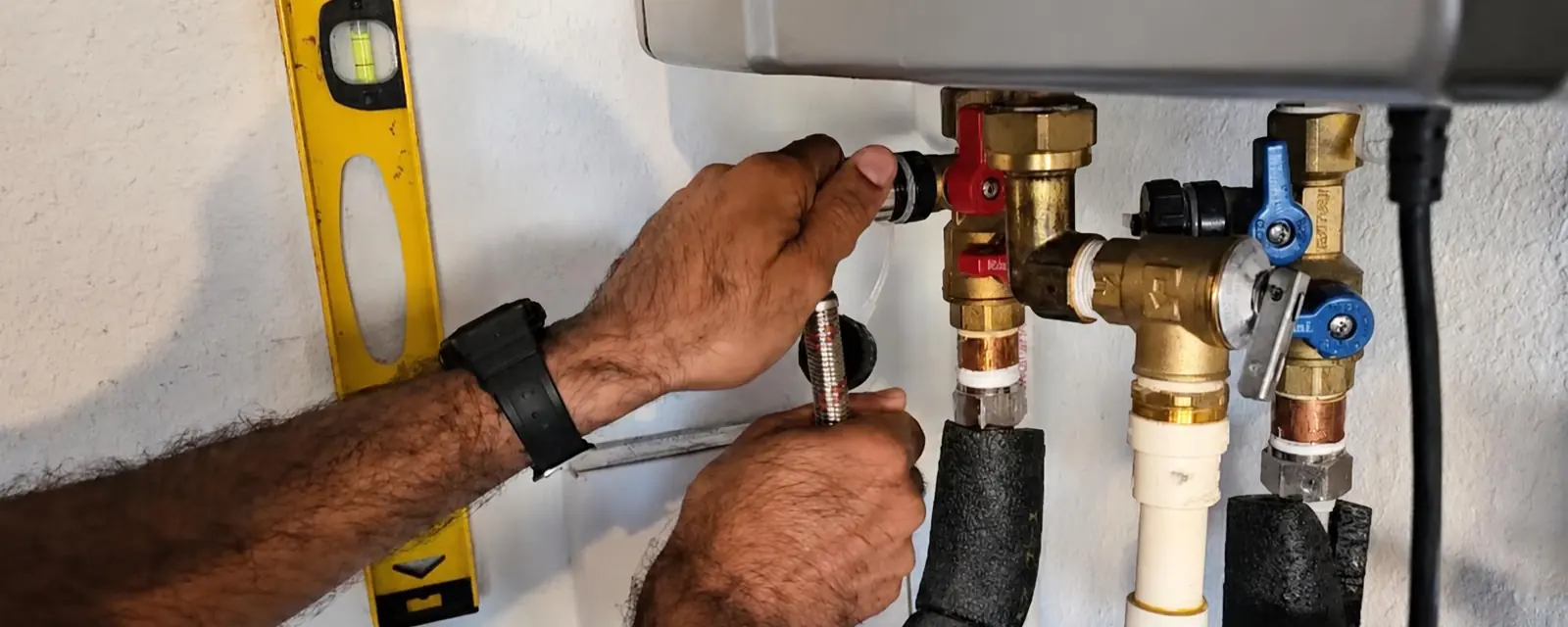
A tankless unit heats water as it flows instead of storing it. That saves floor space, but it also means every part of the system has to be sized and maintained carefully, because there is no tank to cover for a weak link.
We install tankless heaters, convert homes from tank systems and handle the annual flush that keeps them working. For a unit that has stopped heating, see water heater repair. The 24/7 phone line covers urgent failures.
Why hard water makes the yearly descale a must
The City of Westminster's 2024 water quality report lists average total hardness at 252 mg/L, roughly 14.7 grains per gallon, with readings up to 413 mg/L. Heat is what pulls the minerals out of the water, and in a tankless unit the hottest surface is the narrow heat exchanger.
Scale there cuts flow, raises the temperature the burner needs and eventually triggers error codes or a shutdown. A yearly flush with a descaling solution is routine here, and so is checking the inlet screen.
Scale does not announce itself. Longer waits for hot water, a fluctuating temperature and a unit that cycles on and off are all early signs that it is time for a descale.
What the flush involves, step by step
The flush is done through service ports. Most good installs include isolation valves, which is why we recommend them when we put in a new tankless heater.
- 1
Power down
Turn off the gas and electric supply and close the water valves.
- 2
Connect the loop
Hoses link the service ports to a pump and a bucket of descaling solution.
- 3
Circulate
The solution runs through the heat exchanger for the recommended time.
- 4
Rinse and restore
The unit is flushed with clean water, screens are cleaned and the heater is restarted.
Without isolation valves, the flush can still be done, but the valves must be fitted first. That is a short add-on at the time of the visit.
Need tankless water heater in Westminster? Our phone line is open 24/7.
Call (714) 750-8637Gas line size: the check that decides the install
A tankless unit fires at a much higher input than a typical tank. A gas line sized for a 40-gallon heater is often too small once a tankless is added, and a starved burner gives you cold spots and error codes.
We check the pipe diameter and run length before quoting. If SoCalGas is your gas provider and you ever smell gas, leave the house and call 1-800-427-2200 from outside.
Venting and the condensate drain
Tankless heaters need their own vent type, and the vent material depends on the model. Condensing units pull more heat from the exhaust, so they run cooler and usually vent with plastic pipe. Non-condensing units run hotter and need stainless steel vent pipe.
Condensing models also produce acidic condensate, which has to drain to a suitable spot, often through a neutralizer. A garage floor drain or a laundry standpipe can serve, if one is nearby.
| Feature | Condensing | Non-condensing |
|---|---|---|
| Vent material | PVC or similar | Stainless steel |
| Condensate drain | Required | Not needed |
| Efficiency | Higher | Lower |
| Upfront cost | Often higher | Often lower |
Same-day appointments are offered when available. Call to ask about tankless water heater.
Call (714) 750-8637Converting from a tank to tankless in an older house
Many Westminster homes were built around 1971, with a tank heater in the garage or a closet. A swap to tankless means a larger gas line, a new vent and maybe a power outlet, and the old water lines may need attention too.
The conversion is worth doing when you have the space, the gas supply and the budget. For a smaller house with a tight closet, a well-sized tank can still be the practical choice. See water heater installation for the comparison.
Is your house a good fit?
- Gas line can be upsized or run again
- A route for a vent to the outside
- A condensate drain nearby, for condensing units
- A nearby 120-volt outlet
- Hard water plan: flush or softener
- Willingness to maintain it once a year
Error codes and what you can try first
Different makes use different codes, so the manual's code table is your first stop. Before you call, check that the gas valve is open, the breaker is on and the vent is not blocked or the condensate drain backed up.
Codes that return after a reset usually point to scale, a failed sensor or a gas supply problem. Do not remove the cover on a gas appliance. Describe the code to us and we will say what to do next.
Softening the water to protect the heat exchanger
If you do not want to descale every year, softening the water before it reaches the heater is the other option. A water softener cuts mineral deposits at the source. Many owners do both, a softener plus a periodic check.
According to the City of Westminster's 2024 Water Quality Report, average hardness is 252 mg/L and ranges up to 413 mg/L, which is why tankless heat exchangers need regular flushing. Installation follows the California Plumbing Code (Title 24, Part 5) and the maker's instructions.
Tankless water heater questions from Westminster homeowners
How often should a tankless heater be descaled in Westminster?
Once a year is the usual advice for hard water. The City of Westminster reports roughly 14.7 grains per gallon on average, so scale builds up steadily.
Do tankless heaters need a bigger gas line?
Often yes. Their burners draw much more gas than a tank. The pipe size and run length need to be checked before the install.
What is a condensate neutralizer?
A small cartridge that raises the pH of the acidic condensate from condensing units before it goes down the drain. It needs periodic checking.
Why does my tankless heater give cold bursts?
Scale, a clogged inlet screen or very low flow can cause cold bursts. A descale and a filter clean often fix it.
Can you convert my tank heater to tankless?
Usually yes. The gas line, vent, power and drain all need to be checked first, and we explain the work before it starts.
Is it okay to run a tankless heater without isolation valves?
It will run, but the flush becomes much harder to do. Adding valves is a short job and makes yearly service far easier.