
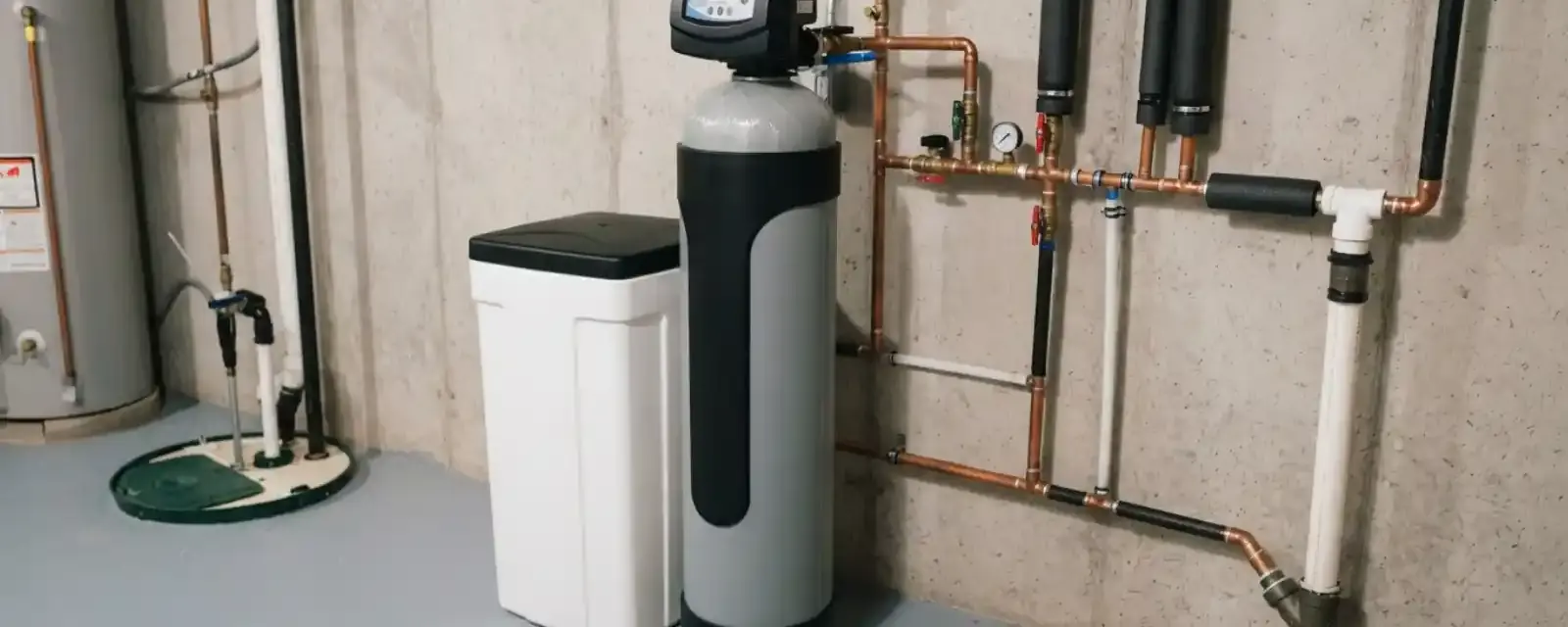
Hard water leaves white crust on faucets, spots on glass and scale inside heaters. A softener fixes the minerals. A filter fixes taste and smell. They are different tools, and plenty of homes need only one of them.
We install and service softeners, whole-house filters and under-sink systems. The phone line is open 24/7 if a unit leaks or a valve fails, and planned installs are scheduled by calling.
What is actually in Westminster tap water
The City of Westminster's 2024 Water Quality Report, using 2023 data, shows total hardness averaging 252 mg/L as calcium carbonate, with a range of 138 to 413. That is roughly 14.7 grains per gallon on average. The water is about 75 percent groundwater from nine wells and 25 percent imported, so hardness can shift from one street or day to the next.
Hardness is the reason for scale on water heaters, tankless heat exchangers, fixtures and garbage disposals. It is not a health issue, but it is a maintenance one. The same report puts pH at 7.9 and lead and copper under action levels.
Softener, filter or reverse osmosis: which one solves what
Start with the symptom. Scale, spotting and dry skin point to hardness. A chlorine-like taste points to a carbon filter. Drinking water that still tastes off after both is a job for reverse osmosis.
| System | Fixes | Does not fix |
|---|---|---|
| Salt-based softener | Scale, spotting, soap use | Taste, chlorine, chloramine |
| Carbon filter | Chlorine taste and odor, some chemicals | Hardness |
| Sediment filter | Grit and particles | Hardness, taste |
| Reverse osmosis (under sink) | Drinking and cooking water quality | Whole-house scale |
Need water softener and filtration in Westminster? Our phone line is open 24/7.
Call (714) 750-8637The chloramine detail most filter guides skip
The city's imported water is chloraminated, and the distribution system holds an average chlorine residual of 0.82 ppm. Chloramine is harder for basic carbon filters to remove than plain chlorine. A catalytic carbon cartridge or a longer contact time helps.
If taste is the problem, say so when you call. That decides whether you need a standard carbon block, a catalytic carbon unit, or an RO system under the kitchen sink.
Sizing a softener for your household
A softener is sized by how many grains of hardness it removes between regenerations. That depends on your water hardness, the number of people and how much water you use. A unit that is too small regenerates too often and wastes salt. A very oversized unit can sit idle and grow stale.
Using roughly 14.7 grains per gallon as a starting point, a household of four using 300 gallons a day removes about 4,400 grains daily. A plumber can run the numbers for your home and pick a capacity from there.
Details to have ready
- Number of people in the home
- Number of bathrooms
- Location with space and a drain nearby
- A nearby electrical outlet
- Whether you have a tankless or tank heater
- Any salt-free or sodium preferences
Same-day appointments are offered when available. Call to ask about water softener and filtration.
Call (714) 750-8637Where it goes and what it connects to
A whole-house softener goes on the main water line after the shutoff and before the heater, with a bypass valve and a drain for its backwash. Garages are the usual spot (see water heater installation for the same location questions) in Westminster's 1970s tract homes, because the main line often enters there.
The regeneration water has to drain somewhere legal and safe, usually a laundry standpipe or floor drain. Ask the Building Division whether a permit applies to your plumbing changes.
Hard water is hardest on the water heater, and a scaled-up tank is a common repair call. If you have a tankless unit, a softener or a yearly descale is close to a must. See tankless water heater service.
Servicing a softener that has stopped working
A softener that no longer softens is usually out of salt, has a salt bridge, or has a stuck valve or a worn resin bed. Check the salt level and break any hard crust in the brine tank before you call.
If the water on the faucets is hard again, the valve may not be cycling. Do not leave a leaking unit running. Close the bypass and call.
Backflow testing and your water supply
Backflow devices protect the public water supply from contamination and appear on irrigation systems and some commercial lines. If you have one, it may need testing on a schedule. Ask the City Building Division at (714) 548-3254 what applies to your property, then call us if a test or repair is needed.
Salt, maintenance and keeping costs predictable
Plan to add salt every month or two, depending on hardness and usage. Clean the brine tank once a year. Filter cartridges are replaced on a schedule, often every six months to a year.
A clear price before work starts means no surprises. Costs vary by system type and installation, from a few hundred dollars for a small under-sink filter to several thousand for a larger whole-house setup. These are typical ranges.
According to the City of Westminster's 2024 Water Quality Report, hardness averaged 252 mg/L and ranged from 138 to 413 mg/L, with a pH of 7.9. Treatment equipment installs follow the California Plumbing Code (Title 24, Part 5).
Water softener and filter questions from Westminster homeowners
How hard is the water in Westminster?
The City of Westminster's 2024 Water Quality Report lists an average total hardness of 252 mg/L, roughly 14.7 grains per gallon. The range was 138 to 413 mg/L.
Will a softener remove chlorine or chloramine?
No. A softener removes hardness minerals. For chlorine or chloramine taste you need a carbon filter, ideally catalytic carbon for chloramine.
Is softened water safe to drink?
Salt-based softening adds a small amount of sodium. Many people keep a separate drinking tap or install reverse osmosis in the kitchen.
Do I need a softener if I have a tankless heater?
It is a good idea. Hard water scales the heat exchanger, so a softener or a yearly descale protects the unit.
Can you repair my existing softener?
Often yes. Salt bridges, stuck valves and worn parts can usually be fixed. If the resin bed is spent, we will say so.
Do you test backflow devices?
Backflow testing is related work. Call and describe the device and we will tell you what applies.