
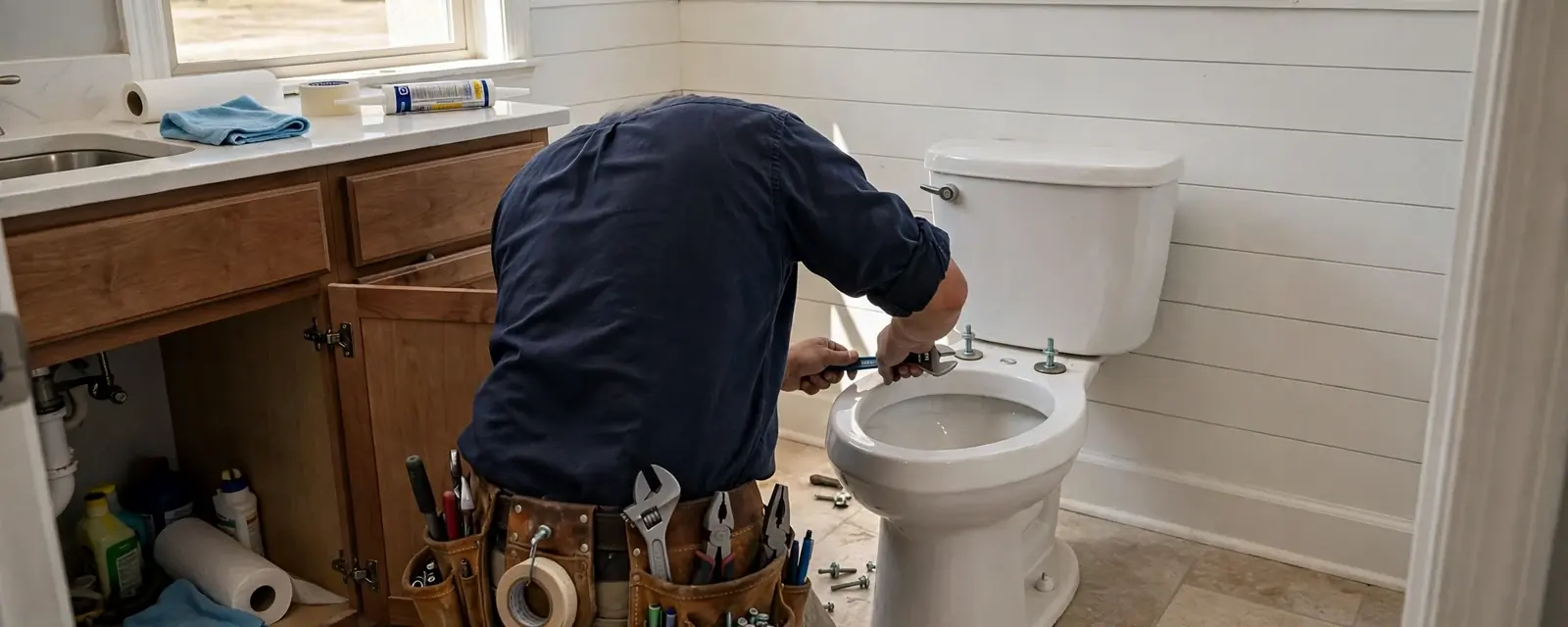
To install a new toilet, shut off the water, drain the old bowl, unbolt it, set a new wax ring on a sound flange, lower the new toilet straight down, tighten the bolts evenly and reconnect the supply line. The whole swap takes a few hours for most people.
What trips people up is not the lifting. It is buying a toilet that does not match the rough-in, or discovering a rusted flange and a soft subfloor after the old one is already off. A little measuring first prevents most of those problems.
If you would rather hand it off, our page on plumbing installation covers fixture replacement. This guide shows the steps so you can judge the job honestly.
Westminster homes have a median build year around 1971, so the closet flange and shutoff valve behind your toilet are often original. Test the valve before you start and inspect the flange once the old toilet is up, since replacing either part costs far less than finding the problem after the new toilet is set.
Measure the rough-in before you shop
The rough-in is the distance from the finished wall behind the tank to the center of the floor drain flange. Most toilets are built for a 12 inch rough-in, but 10 inch and 14 inch versions exist. Buy the wrong one and the toilet will sit too close to the wall or too far from it.
Measure to the center of the closet bolts, not to the edge of the old toilet base. Also note whether the bowl is round or elongated, and whether the floor space allows for the longer shape.
| Measurement | How to take it | Why it matters |
|---|---|---|
| Rough-in | Wall to center of closet bolts | Decides which model fits |
| Bowl shape | Round or elongated | Affects comfort and clearance |
| Door swing | Check space in front of the bowl | Avoids a door that hits the toilet |
| Supply valve position | Height and distance from the bowl | Sets supply line length |
Gather tools and parts first
Nothing is more frustrating than a bathroom with no working toilet and a missing part. Lay everything out before you touch the shutoff valve.
Buy a new wax ring, new closet bolts, a new braided supply line and a fresh set of tank bolts and washers if your toilet kit does not include them. Reusing an old wax ring is the most common cause of a leak at the base.
Parts and tools to have ready
- New toilet with seat and tank hardware
- New wax ring, with or without a plastic horn
- New closet bolts and plastic caps
- New braided stainless supply line
- Adjustable wrench, screwdriver and putty knife
- Old towels, a bucket and a sponge
Removing the old toilet without a mess
Close the oval shutoff valve behind the toilet by turning it clockwise. Flush to empty the tank, then sponge out what is left in the tank and bowl. Disconnect the supply line with a wrench and have a towel ready for drips.
Pop the caps off the closet bolts and loosen the nuts. Rock the toilet gently to break the old seal, then lift it straight up. A toilet is heavy, so bend your knees or get help, and set it on cardboard or a towel.
Stuff a rag into the drain opening right away. That keeps sewer gas out and prevents dropped parts from falling in.
Inspect the flange and the floor
Scrape off the old wax with a putty knife and look closely at the flange. It should be firmly screwed to the subfloor, free of cracks and sitting at or slightly above the finished floor. A flange sunk below the floor will not seal a new wax ring well.
Press on the floor around the flange. Soft, dark or spongy wood means a slow leak has been rotting the subfloor. That is a repair to finish before a new toilet goes on, and it is a good moment to stop and call a plumber.
A cracked flange, a rusted ring, a soft floor or a drain that sits below the finished floor are not quick fixes. A flange repair kit helps with minor damage, but major damage needs a plumber and sometimes a carpenter.
Set the wax ring and lower the toilet
Place new closet bolts in the flange slots with the threads pointing up. Set the wax ring on the flange, or on the toilet horn if the instructions say so, with the flat side facing the right direction.
Line up the bolt holes and lower the toilet straight down in one smooth move. Do not twist or slide it, since that smears the wax and weakens the seal. Press down firmly with your body weight, then add washers and nuts.
- 1
Prepare the flange
Clean it, check the bolts and confirm the surface is level.
- 2
Place the wax ring
Seat it centered, without squashing or tearing it.
- 3
Lower the toilet
Drop it straight down over the bolts, then press firmly.
- 4
Tighten evenly
Alternate sides a little at a time until the base is snug.
Tighten carefully, connect and test
Tighten the nuts a half turn on one side, then the other. Porcelain cracks when one side is over-torqued, so stop when the toilet no longer rocks. Trim the bolts with a hacksaw and snap on the caps.
Attach the tank to the bowl if it is a two-piece model, using new washers. Then connect the supply line, open the shutoff valve slowly and let the tank fill. Flush several times and check the base, the tank bolts and the supply connection with dry tissue.
- No water around the base after three flushes
- No rocking when you press on either side
- Tank fills and shuts off cleanly
- No hissing or dripping from the supply line
What older Westminster homes tend to hide
Most Westminster neighborhoods were built in the 1960s, and the median home dates to about 1971. That age means original flanges, original shutoff valves and old subfloor around bathrooms that may have seen decades of small leaks. The practical step is to test the angle stop valve before you start and replace it if it will not close fully.
Hard water adds another wrinkle. The City of Westminster reports roughly 14.7 grains per gallon, and that scale can seize old valves and coat the fill valve seat. If your toilet runs after install, see our notes on toilet repair.
If the new toilet drains slowly or other fixtures gurgle, the cause may be farther down the line. A sewer line cleaning visit can tell you whether the main is partially blocked.
Permits and when to hire it out
A like-for-like toilet swap is usually simple, but moving a toilet or changing the drain is different. The City Building Division at 8200 Westminster Blvd, (714) 548-3254, can tell you whether a permit applies. The city permit worksheet lists fixtures among permit items.
Call a plumber if the flange is damaged, the floor is soft, the drain needs to move or you cannot lift the toilet safely. We serve Westminster and nearby towns, including Garden Grove, and give a clear price before work starts. See our service areas for the full list.
Toilet and flange installation follows the California Plumbing Code (Title 24, Part 5). The City Building Division, (714) 548-3254, can say whether a permit applies to a bathroom project.
Toilet installation questions from Westminster homeowners
How long does it take to install a new toilet?
Plan on two to four hours for a first-time swap with no surprises. A damaged flange or soft floor adds time and may need a plumber.
Can I reuse the old wax ring?
No. A wax ring seals once and keeps the shape of the first toilet. Use a new ring every time the toilet comes off the floor.
What is a rough-in and why does it matter?
It is the distance from the wall to the center of the closet bolts. Most toilets need a 12 inch rough-in, and buying the wrong size leaves the toilet crooked or too close to the wall.
Does a new toilet need a permit in Westminster?
Ask the City Building Division at (714) 548-3254. A simple replacement and a relocation are treated differently, so describe your job when you call.
Why does my new toilet rock?
An uneven floor or an over-tightened bolt is usually the cause. Plastic shims can level it, and caulk around the base afterward hides the gaps.
Should I replace the supply line with the toilet?
Yes. A new braided line costs little and removes a common hidden leak, especially on a heavily used fixture.