Electric tank heaters have two thermostats, an upper and a lower, plus a high-limit reset button. When one fails, you may get water that is never hot enough, water that runs out fast, or a tripped breaker. Replacing a thermostat is a modest repair, and the part is inexpensive compared with a new tank.
Safety comes first. The heater runs on 240 volts, and a mistake can seriously hurt you. This guide covers how to shut off power, test the parts, swap a thermostat, and decide when the tank is the real problem and water heater replacement makes more sense.
Westminster water averages 252 mg/L of total hardness, roughly 14.7 grains per gallon, and it ranges up to 413. That hardness leaves scale on heating elements, which makes them work harder and can mimic a thermostat problem. Before you buy a thermostat, flush the tank and check the elements, because scale is often the real reason the water runs out fast.
Is it really the thermostat? Symptoms to match first
Several different failures look alike from the shower. Matching your symptom to the likely part saves you from buying the wrong one. A heater with no hot water at all points to power, the high-limit switch, or the upper thermostat. Lukewarm water that runs out quickly often points to the lower thermostat or a bad lower element.
| Symptom | Likely cause | First check |
|---|---|---|
| No hot water | Tripped breaker, high-limit, upper thermostat | Breaker, then reset button |
| Lukewarm water | Lower thermostat or lower element | Test lower thermostat |
| Water too hot | Stuck thermostat contacts | Lower the dial and retest |
| Hot water runs out fast | Scale, bad lower element, or sediment | Flush tank, test element |
| Breaker keeps tripping | Shorted element or wiring | Stop and call a plumber |
Turn the power off the right way
Switch off the double-pole breaker for the heater at the main panel. Tape over it or tell everyone in the house so no one turns it back on. Do not rely on the thermostat dial or a wall switch, since those do not kill the power to the wires.
Then confirm with a non-contact voltage tester or a multimeter at the thermostat terminals. If the tester still shows voltage, you have the wrong breaker or a wiring problem. Stop and do not touch the wires.
A breaker label can be wrong, especially in older homes. A water heater has 240 volts across two live legs. Test the terminals yourself every time before your hand goes inside the access panel.
Tools and parts you need before you open the panel
Gather everything first so you are not hunting for parts with the cover off. Match the thermostat to your heater. Most are the snap-action type, but the mounting clips and the high-limit design vary, so bring the old part or the model label when you shop.
Pre-job checklist
- Replacement thermostat that matches your heater model
- Non-contact voltage tester and a multimeter
- Insulated screwdriver
- Phone camera for a wiring photo
- Flashlight or headlamp
- Needle-nose pliers
- Electrical tape and a label for the breaker
Step-by-step: swapping an upper or lower thermostat
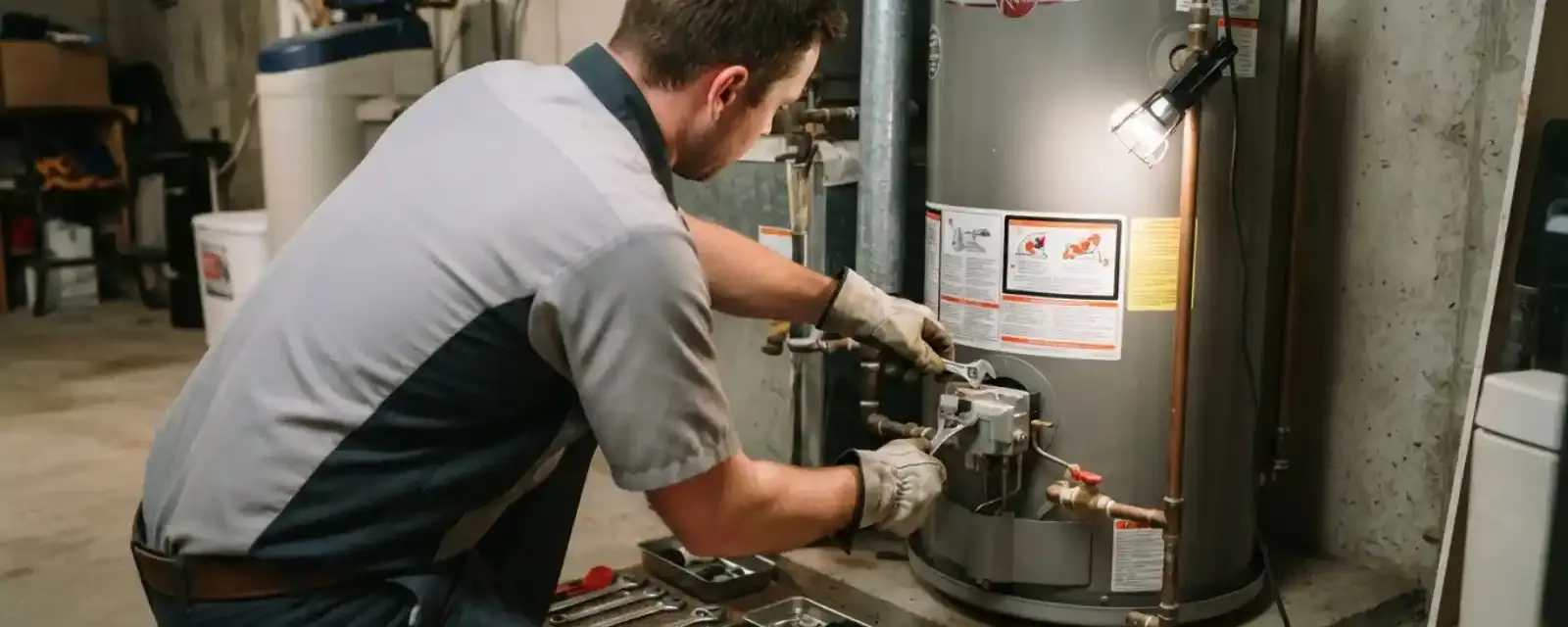
Work slowly and take a photo of the wiring before disconnecting anything. The upper thermostat is wired to the high-limit switch and the lower one is wired through the upper, so mixing up wires causes real problems.
- 1
Remove the access panel
Take off the metal cover and fold back the insulation. Photograph the wires and test for voltage again.
- 2
Disconnect and remove the old thermostat
Label each wire, loosen the terminal screws, and pull the thermostat free of its spring clips.
- 3
Seat the new thermostat
Slide it in so it sits flat against the tank wall. A gap means a wrong reading and uneven heating.
- 4
Reconnect wires and restore power
Match your photo, tighten the screws, set the dial, replace insulation and panel, then flip the breaker on.
Set the temperature to about 120 degrees F for most households. Higher settings raise scald risk and speed up scale. Wait an hour or two and check the water at a tap.
How to test the parts with a multimeter
With the power off and the wires removed, set the meter to ohms. A good element reads some resistance, often between 10 and 30 ohms depending on wattage. A reading of zero or infinity means the element has failed.
A thermostat can be checked for continuity across its terminals when the dial is set to call for heat. If it shows no continuity, replace it. If the thermostat tests fine and the element tests fine, the high-limit button or the wiring is next.
- Element reads zero ohms: shorted, replace it
- Element reads infinite resistance: open circuit, replace it
- Element tests to ground: dangerous, replace it
- Thermostat shows no continuity when calling for heat: replace
- Everything tests normal: look at wiring and the reset button
Scale, sediment and the hard water factor
Hot tanks in hard water areas collect scale on the elements and a layer of sediment on the bottom. A scaled lower element heats slowly and can burn out. A thick sediment layer insulates the water from the element, so the thermostat shuts off early.
Draining a few gallons from the bottom valve into a bucket tells you quickly if the tank is full of grit. If it comes out cloudy with chunks, flush the tank fully, and consider water softening or filtration to slow the buildup.
When to stop and call a plumber instead
Stop if the breaker keeps tripping, if you see burnt or melted wires, if water is leaking from the tank or fittings, or if you are not comfortable working near 240 volts. Those are signs of a bigger fault than a thermostat.
If the tank is older, a leak at the bottom or rusty water means the steel liner is failing and no thermostat will help. A water heater repair visit can sort out what is worth fixing. Our phone line is answered 24/7 for urgent failures.
| Situation | Better choice |
|---|---|
| Thermostat fails, tank dry and sound | Replace the thermostat |
| Element burned out, tank sound | Replace the element |
| Water at the base of the tank | Plan for a new tank |
| Rusty hot water from every tap | Plan for a new tank |
Local rules, bracing and nearby towns
California Health and Safety Code section 19211 requires new and replacement water heaters to be braced, anchored or strapped. If you end up replacing the tank, the new one must be strapped for earthquake safety. Ask the City Building Division at (714) 548-3254 whether a permit applies to your project.
We serve Westminster, Midway City and nearby towns, including Garden Grove. See our service areas for the full list.
Work on water heater controls should follow the maker's instructions and the California Plumbing Code (Title 24, Part 5). California Health and Safety Code section 19211 also requires heaters to be braced, anchored or strapped.
Water heater thermostat questions
Can I replace a water heater thermostat myself?
Many homeowners can, if they shut off the breaker and confirm no voltage. If you are unsure about working with 240 volts, call a plumber instead.
How do I know which thermostat failed, upper or lower?
No hot water at all usually points to the upper thermostat or high-limit. Lukewarm water that runs out quickly points to the lower. Testing with a multimeter confirms it.
What temperature should I set my water heater?
About 120 degrees F is a common setting for homes. It reduces scald risk and slows scale. Raise it only if you have a specific need.
Is hard water in Westminster a problem for my water heater?
Yes. Water averaging roughly 14.7 grains per gallon leaves scale on elements and sediment in the tank. Flushing the tank and checking elements helps hot water last longer.
Why does my water heater breaker keep tripping?
A shorted element or damaged wiring usually causes it. Do not keep resetting the breaker. Turn it off and call a plumber.
When is it time to replace the whole water heater?
Leaks from the tank, rusty hot water, or repeated failures mean the tank is wearing out. A new thermostat will not fix a corroded tank.