
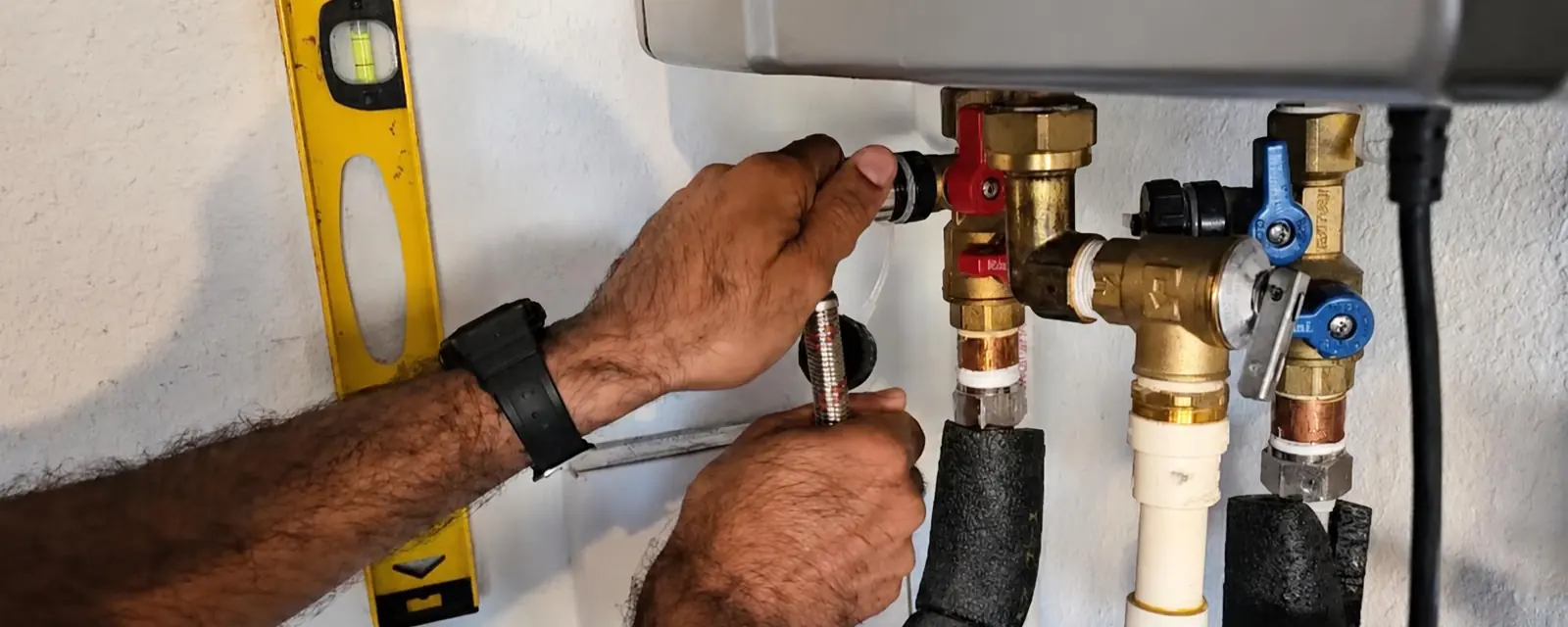
Most owners open the manual once, then lose it. That is a mistake, because the manual lists the error codes, the flush schedule, the venting limits and the gas and water requirements for your exact model. If you do not have it, the model number on the unit's label usually leads to a free download from the maker.
This guide walks through what to look for, in the order that matters. It does not name brands, since layouts differ, but nearly every manual covers the same ground. Start with the maintenance pages, because hard water is the biggest threat to a tankless water heater in this area.
Westminster tap water averages 252 mg/L of total hardness, roughly 14.7 grains per gallon, and readings range up to 413. Scale forms on the heat exchanger and shrinks the passages that water flows through. Check the manual's flush section and plan on an annual descaling, or sooner if you see temperature swings or error codes.
Find the model number and the right manual first
The rating label on the side or bottom of the heater shows the model and serial number. Write both down and keep a photo on your phone. Manuals often cover several models, so make sure the tables you read match your number.
If the installer left a packet, look for the quick-start card, the warranty page and any installer notes. Do not rely on a manual for a different model, since gas pressure, vent size and flow rates change from one to the next.
Gather before you read
- Model and serial number photo
- Manual or PDF for that exact model
- Installation date
- Gas type (natural gas or propane)
- Whether it has isolation valves
- Notes from any past service visit
Error codes: the table you will use most
Nearly every manual has an error code chart with a number, a meaning and a suggested action. Codes are grouped by cause: ignition, flame, temperature sensors, venting, water flow and scale. Look up your code before you restart anything.
Some codes clear with a simple reset. Others warn of a safety shutdown, so do not keep resetting a unit that fails again. Note the code and the time, then decide whether the fix is yours or a plumber's.
| Code group | What it often means | Reasonable first step |
|---|---|---|
| Ignition or no flame | Gas off, low pressure or dirty igniter | Check the gas valve and other gas appliances |
| Overheat or sensor | Scale or flow problem | Check flow, then plan a flush |
| Vent or exhaust | Blocked or disconnected vent | Stop using the heater and call a plumber |
| Low flow | Clogged inlet filter or closed valve | Clean the inlet screen, open valves |
| Condensate or drain | Blocked drain or full trap | Clear the condensate line |
Flush and descale instructions
Look for a section called maintenance, descaling or flushing. It lists the valves to close, the hoses to attach and the amount of descaling solution or white vinegar to circulate. The usual time is 45 minutes to an hour with a small pump.
Isolation valves make this easy. Without them, a plumber must add valves first. If your unit lacks them, ask about installing them before the first flush.
- 1
Shut off power and gas
Turn off the unit and close the gas valve, then close the cold and hot isolation valves.
- 2
Connect the hoses
Attach one hose to the service port on each valve and run the loop to a bucket with solution.
- 3
Circulate
Run the pump for the time the manual lists, usually about an hour.
- 4
Rinse and restore
Flush with clean water, remove the hoses, clean the inlet screen, and reopen the valves.
Grit collects on the small filter at the cold water inlet. A clogged screen cuts flow and can trigger low flow codes that look like a heater failure.
Venting, clearances and condensate
The venting chapter lists approved pipe types, maximum lengths, the number of elbows allowed and the clearance to windows and openings. Never change the vent without reading it. A bad vent can let exhaust gases back into the home.
Condensing models also drain acidic condensate. The manual shows where the drain goes and whether a neutralizer cartridge is needed. Check that the drain line stays clear and slopes properly.
- Approved vent material and diameter
- Maximum straight length and elbow count
- Clearance to windows, doors and meters
- Condensate drain slope and neutralizer notes
- Combustion air requirements for the room
Flow rate, temperature settings and why showers go cold
Every tankless unit has a maximum flow rate in gallons per minute at a certain temperature rise. In cold months the incoming water is colder, so the unit gives fewer gallons at the same hot temperature. The manual's chart shows this trade-off.
If two showers and a dishwasher run at once, the unit may hit its limit and the water cools. This is a sizing issue, not a defect. Lowering the set temperature a few degrees often stretches the flow.
Gas and water requirements worth double-checking
The installation pages list gas input in BTU, the gas line size and the minimum gas pressure. A unit that fires poorly on a busy day may have a line that is too small. That needs a plumber or gas fitter, not a manual reset.
If you ever smell gas, leave the house and call from outside. If SoCalGas is your gas provider, the emergency line is 1-800-427-2200. Call 911 if anyone is in danger, and do not touch light switches.
Do not troubleshoot a gas smell with the manual. Get out, call from outside or from a neighbor's phone, and wait for the utility to clear the home.
Maintenance schedule you can paste on the wall
Most manuals recommend annual professional service and more frequent owner checks. Put the schedule on a note near the unit so the next person in the house knows what to do.
| Task | How often | Who |
|---|---|---|
| Clean inlet screen | Every 6 to 12 months | Owner |
| Flush and descale | At least yearly in hard water | Owner or plumber |
| Check vent and condensate drain | Yearly | Owner or plumber |
| Inspect gas connections and burner | Yearly | Plumber |
| Test pressure relief and valves | Yearly | Plumber |
If scale returns fast, a softener or filtration system upstream can slow it. For failures the manual cannot solve, water heater repair is the next stop.
When the manual says call a professional
Treat these lines as hard limits: gas conversions, vent changes, and replacing the burner or heat exchanger. Also note any language about permits, since the City Building Division at (714) 548-3254 can tell you whether a permit applies to a replacement.
We serve Westminster, Midway City and nearby areas, including Garden Grove. See where we work for the list. Our phone line is answered 24/7 for urgent failures.
Follow the maker's manual first, because installation and service rules come from it and from the California Plumbing Code (Title 24, Part 5). According to the City of Westminster's 2024 Water Quality Report, hardness averages 252 mg/L, so the flush schedule matters.
Tankless water heater manual questions
Where can I find my tankless water heater manual?
Look for the model number on the unit's rating label, then search the maker's support page for that exact model. Save a copy on your phone.
How often should I flush a tankless heater in Westminster?
Westminster water averages roughly 14.7 grains per gallon, so annual flushing is a sensible starting point. Follow your manual if it asks for more often.
What should I do when my tankless heater shows an error code?
Look up the code in the manual, note it, and try only the listed reset. If it returns, or the code is about venting or gas, stop and call a plumber.
Why does my tankless heater give lukewarm water?
Common reasons include scale, a clogged inlet screen, or too many fixtures running. Check the flow rate chart in the manual.
Can I change the vent pipe myself?
No. The manual limits vent type, length and elbows for safety. Have a licensed plumber do vent changes.
Does the manual cover gas line size?
Yes, the installation section lists the gas input and the line size needed. If your unit starves for gas at peak use, the line may be too small.