
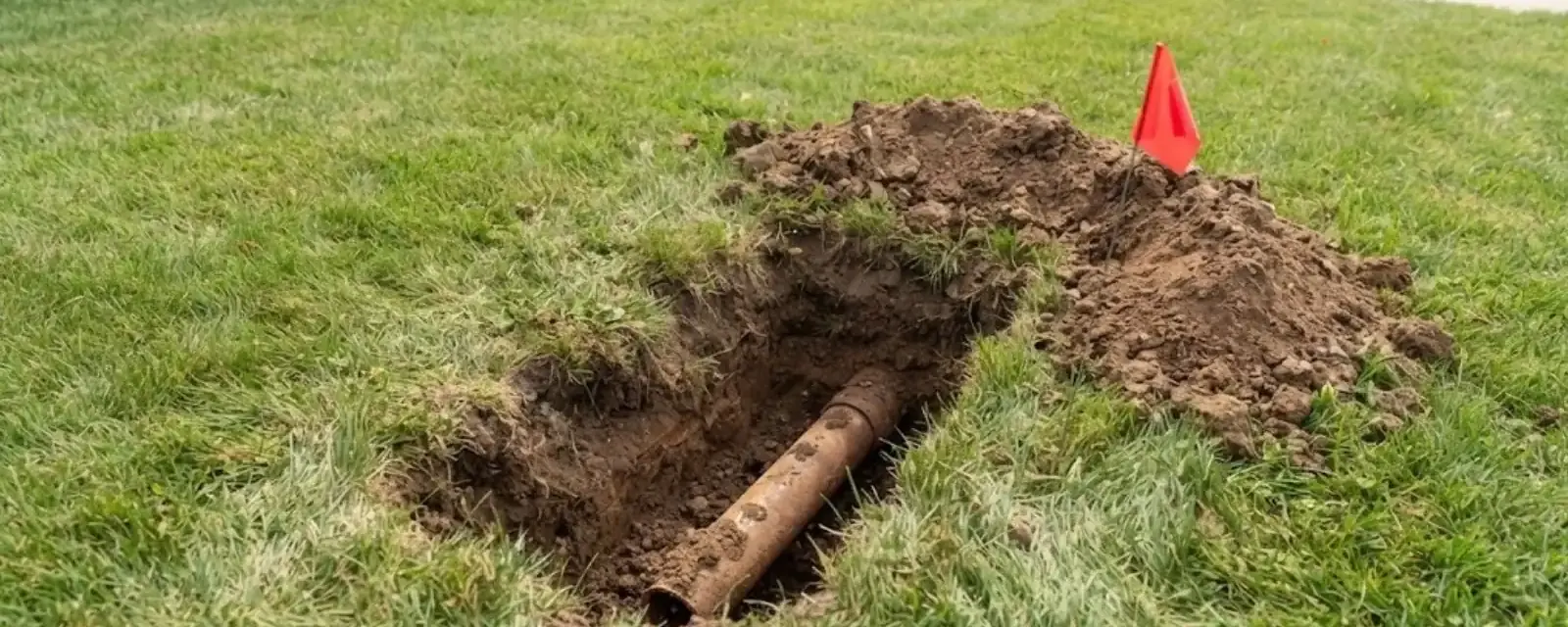
Trenchless sewer repair means fixing the pipe from the inside or pulling a new one through the old path. Instead of a long open trench, a crew digs one or two small pits. The two main methods are pipe lining, which creates a new pipe inside the old one, and pipe bursting, which breaks the old pipe and pulls in a new one.
Neither method fits every pipe. The deciding factor is the condition and shape of the line, and the only way to know is a camera look first. This guide covers how each method works, what limits them, and what to ask before you agree to work. For standard repair choices, see sewer line repair.
Most Westminster neighborhoods were built in the 1960s, and the median home dates to about 1971. Sewer laterals from that era were commonly clay, cast iron, or fiber materials that break down with age and root intrusion. A camera inspection tells you which material you have, which decides whether lining or bursting is even possible.
Signs your sewer line may need more than a cleaning
A sewer line that fails does not always flood the house. Early signs are subtler. Slow drains throughout the house, gurgling toilets, a sewage smell in the yard, or lawn patches that stay green and soggy over the line all point to trouble.
If cleaning clears the line but the clog returns within weeks or months, the pipe itself may be cracked, offset or invaded by roots. That is the point to consider repair instead of repeating cleanings.
Warning signs to watch
- Multiple fixtures draining slowly at once
- Gurgling in tubs or toilets after flushing
- Sewage odor near the cleanout or yard
- Wet or sunken spots over the sewer path
- Clogs returning soon after each cleaning
- Floor drain backing up
Camera first: why you should never skip the inspection
A camera on a flexible cable travels the length of the line and shows cracks, root masses, bellies where water pools, joints that have shifted, and the pipe material. Without that picture, any price is a guess.
Ask for the footage and the approximate distance to each problem. A sewer camera inspection also shows if the damage is one short section or the entire run, which changes the best repair.
Keep a copy of the video and notes. It helps when comparing quotes, when you talk with the Building Division, and if you sell the home later.
How pipe lining works
Lining uses a flexible tube soaked in resin. The crew cleans the old pipe, pulls the tube in through an access point, inflates it so it presses against the pipe wall, and lets the resin cure hard. The result is a smooth pipe inside the old one.
Lining is good for cracks, small holes, root-prone joints and rough interior walls. It does not straighten a pipe, fix a major sag, or rebuild a collapsed section. The line must be cleaned first, often by hydro jetting, so the liner bonds well.
- 1
Clean the pipe
Cut roots and scour scale and debris so the liner can sit tight.
- 2
Inspect again
Run the camera to confirm the pipe is open and the shape is suitable.
- 3
Install the liner
Pull the resin tube in and inflate it against the pipe wall.
- 4
Cure and verify
Let the resin harden, reopen service connections and camera the result.
How pipe bursting works
Bursting uses a cone-shaped head pulled through the old pipe by a cable or hydraulic rig. The head cracks the old pipe outward into the soil while pulling in a new pipe behind it. It makes a full new pipe, not a liner inside the old one.
It suits pipes that are badly cracked, broken in several places or too deformed for lining. It needs entry and exit pits and clear space for the new pipe. Nearby utilities, tight sections and hard soil can limit it.
Lining versus bursting versus open trench
No method wins in every case. The camera, pipe material, depth, slope and what sits above the line decide which option fits. This table shows how the choices usually compare.
| Method | Best for | Limits | Digging |
|---|---|---|---|
| Spot repair | One short broken section | Does not help the rest of the line | One pit |
| Pipe lining | Cracks, roots, rough walls | Not for collapses or major sags | Small access pits |
| Pipe bursting | Badly cracked or failing pipe | Needs pits and clear path | Two pits |
| Open trench | Collapsed, offset or bellied pipe | Disrupts yard and hardscape | Full length |
When trenchless is not the right answer
If the pipe has collapsed, has a deep belly that holds water, or has sharp offsets at the joints, a liner will follow the same bad shape. Fiber-type pipe from the mid-century era can be too soft or crushed for lining. In these cases a full replacement is more honest than a patch.
Some pipe also has a bad connection at the house or the street. Trenchless methods may repair the middle but not the ends, so ask exactly where the new pipe begins and ends.
- Collapsed or crushed sections
- Deep sags that hold standing water
- Sharp bends or offsets at joints
- Soft or deteriorated pipe material
- Many service connections that would need reinstating
What drives the cost and what to ask
Cost depends on pipe length, depth, number of access pits, pipe diameter, the method and any surface restoration. Typical trenchless jobs often run a few thousand dollars and can climb to several thousand more on long or deep lines. Prices vary a lot, so get the scope in writing.
Our policy is a clear price before work starts. Ask any contractor what is included, where the repair starts and stops, and how the finished line will be tested. Ask for a post-repair camera video.
| Question | Why it matters |
|---|---|
| Where does the repair begin and end? | Avoids untreated sections at the ends |
| What does the camera show? | Confirms the method fits the pipe |
| Is a post-repair video included? | Verifies the finished work |
| What surface restoration is included? | Sets expectations for the yard |
| Does a permit apply? | Keeps the work on the record |
Permits, the sanitary district and who to ask
Sewer service for all of Westminster and Midway City comes from the Midway City Sanitary District, which runs four lift stations and has an office at 14451 Cedarwood St, (714) 893-3553. Where the district's responsibility ends and yours begins is not something to assume. Ask the district or a plumber to confirm where the property line responsibility starts before you plan a repair.
Ask the City Building Division at (714) 548-3254 whether a permit applies. Its permit worksheet lists building sewer work. The Building Division is at 8200 Westminster Blvd and takes walk-ins Monday through Friday. If your main line is only clogged, sewer line cleaning may be enough for now.
We serve Westminster, Midway City and nearby towns, including Garden Grove. See our service areas for details. Our phone line is answered 24/7 for sewer backups.
According to the Midway City Sanitary District, it serves all of Westminster and Midway City. Building sewer work is listed on the City Building Division's permit worksheet, and repairs follow the California Plumbing Code (Title 24, Part 5).
Trenchless sewer repair questions
What is trenchless sewer repair?
It is a way to repair or replace a sewer pipe with little excavation. Before any digging, call 811 so underground utilities can be marked. The common methods are pipe lining and pipe bursting, both done from small access pits.
Can every sewer line be lined?
No. Lining works on pipes that are open and reasonably straight. Collapsed pipe, deep sags and badly offset joints usually need bursting or open trench replacement.
Do I need a camera inspection first?
Yes. The footage shows pipe material, damage and slope. Without it, nobody can say which method fits.
Is trenchless repair possible on a 1960s Westminster home?
Often it is, but it depends on the pipe. Many homes here date to around 1971, and older clay or fiber pipe may be too damaged for lining. A camera look answers it.
Does trenchless repair need a permit?
Ask the City Building Division at (714) 548-3254 whether a permit applies. The permit worksheet lists building sewer work.
Who is responsible for the sewer lateral in Westminster?
Do not assume. Ask the Midway City Sanitary District or a plumber to confirm where property line responsibility starts.