
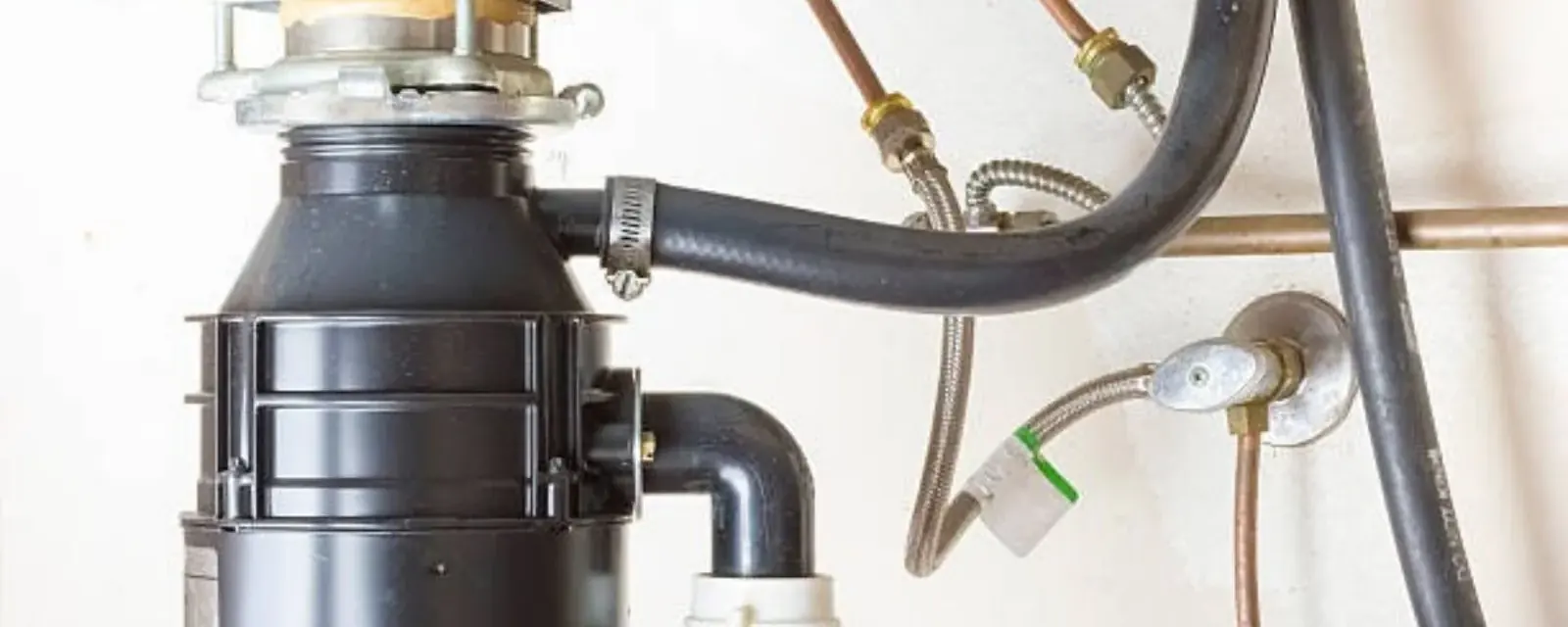
An air gap is a short vertical break between two pipes, with plain air in the middle. Water can fall across the gap going forward, but it cannot climb back up. That makes it the simplest and most reliable form of backflow prevention in a house.
The one most homeowners meet is the small chrome or plastic cylinder next to the kitchen faucet. It sits between the dishwasher and the disposal or drain. If water spits out of it or the dishwasher will not empty, the gap is clogged and a fix is usually within reach.
This guide explains how air gaps work, how they differ from a high loop, how to clear a blocked one, and when the problem is bigger than the gadget on your countertop.
Most Westminster homes were built in the 1960s and early 1970s, with a median build year of about 1971. Original kitchens often have old dishwasher drain hoses and disposal connections that have never been replaced, so a hose that has stiffened or cracked can cause leaks that look like an air gap problem. Check the hose condition when you clean the gap.
How a kitchen air gap actually works
The dishwasher pumps its dirty water up through a hose to the air gap. The water crosses an open space inside the cylinder and drops into a second hose, which runs down to the disposal or a sink tailpiece. Because the two hoses never touch, nothing can siphon backward.
That matters because the drain side can hold food waste, grease and bacteria. If the sink backed up, the gap stops that water from rising into the dishwasher where your dishes are cleaned.
The cap you see on the countertop is only the outlet. Inside, a short plastic body with two barbed nipples does the work, and that is where debris collects.
A little water on the counter around the cap is not a defect in the design. It is the overflow path. The gap is built to spill there rather than let dirty water flow backward into the dishwasher.
Air gap versus high loop: which one does your house have
Many kitchens have no countertop cylinder at all. Instead, the dishwasher drain hose is looped up high under the sink and fastened to the underside of the counter. That is called a high loop, and it uses gravity to hold the water back.
A high loop works well when it is installed correctly. It fails when the hose sags, gets knocked loose, or is never fastened up at all. A sagging loop lets sink water creep back toward the dishwasher.
Look under the sink to tell which you have. A countertop cylinder with two hoses below it is an air gap. A single hose arching up to the counter underside is a high loop.
| Feature | Air gap | High loop |
|---|---|---|
| Where you see it | Cylinder on the countertop or sink deck | Hose arched under the counter |
| How it blocks backflow | Open air space | Gravity and height |
| Common failure | Clogged with food and scale | Hose sags or comes loose |
| Visible symptom | Spitting or leaking at the cap | Dishwasher holds dirty water |
| Upkeep | Unscrew the cap and clean | Re-fasten the hose higher |
Signs your air gap is clogged
A clogged air gap behaves like a clogged drain at the dishwasher. The water has nowhere to go, so it looks for the lowest escape route, and the cap is that route.
Gurgling during the drain cycle, water bubbling up through the cap, and a dishwasher that finishes with a puddle in the bottom are the classic signs. A musty smell from the machine often follows.
When to call: symptoms of a blocked air gap
- Water spits or sprays from the cap during the drain cycle
- Standing water in the bottom of the dishwasher after a cycle
- Gurgling noises near the sink while the dishwasher runs
- A sour or musty odor from the dishwasher
- Wet cabinet floor under the sink
How to clean an air gap yourself
This is a ten-minute job with no special tools. Turn the dishwasher off at the panel or unplug it first, so it cannot run while you work.
- 1
Remove the cap
Twist or pull the chrome cap off the cylinder. Some are held by a small set screw, so check the side.
- 2
Lift out the inner cover
Take out the plastic insert and look for slime, coffee grounds, rice and gritty scale.
- 3
Clear the barbs
Use a small bottle brush or a straightened paper clip to push debris out of both openings.
- 4
Flush and reassemble
Rinse with warm water, replace the parts, and run a short cycle while watching the cap.
If water still spits after cleaning, the blockage is probably in the hose below the gap or in the disposal inlet. Do not pour drain chemicals into the gap. They sit in the cylinder and can damage the plastic and the disposal.
When the clog is in the disposal or the hose
The gap is only the middle of a path. Water leaves the dishwasher, passes the gap, then enters the disposal inlet. If the disposal's knockout plug was never removed during installation, the dishwasher cannot drain at all.
A hose with a kink, a packed disposal inlet, or grease further down the line will all back water up to the gap. A garbage disposal repair visit often solves the real cause.
If the kitchen sink itself drains slowly too, the problem has moved past the dishwasher and into the branch line. That is a job for drain cleaning rather than a gap cleanout.
Hard water and the Westminster kitchen
The City of Westminster 2024 Water Quality Report lists average total hardness of 252 mg/L, roughly 14.7 grains per gallon. In practice that means scale forms inside narrow passages, including the small barbs of an air gap and the disposal inlet.
Cleaning the gap every few months keeps scale from narrowing the opening. A splash of white vinegar in a bowl for the removed parts loosens mineral crust. If scale keeps returning quickly, a softener or filter reduces it at the source.
Air gaps beyond the dishwasher
The same idea shows up in other places. A drain line from a water softener, a reverse osmosis unit, or a condensate pump often ends a few inches above a floor drain or standpipe. That open space is an air gap, and it is required to keep drain water from flowing back into the equipment.
On the supply side, outdoor faucets and irrigation systems use backflow devices to protect drinking water from yard contamination. Those are different parts but they serve the same purpose.
The City Building Division permit worksheet lists backflow devices among the items it tracks. Ask the Building Division at (714) 548-3254 whether a permit applies before adding or replacing one.
Testable devices: where the air gap idea meets backflow assemblies
Some properties need more than a simple gap. Irrigation lines, fire sprinklers and commercial kitchens often use mechanical assemblies, such as a reduced pressure zone device, that close valves when pressure drops. These need periodic testing by a certified tester.
A typical home does not have one indoors. If you see a bronze device with two shutoff handles near a hose bib or irrigation line, it is a backflow assembly, so leave it alone and ask a plumber about testing. For shops and restaurants, see commercial plumbing.
Capping the gap or running the hose straight into the disposal to stop leaks removes backflow protection. Fix the clog and keep the gap in place.
When to stop and call a plumber
Cleaning a gap is safe homeowner work. Anything that involves cutting pipe, moving a sink drain, or replacing a disposal is better left to a licensed plumber, especially if the cabinet floor has been wet for a while.
We cover Westminster, Midway City and nearby towns, including a neighboring Garden Grove plumber service area. See the areas we serve for the full list. Call (714) 750-8637 any time to describe what you see.
Air gaps and backflow protection are covered by the California Plumbing Code (Title 24, Part 5). The City Building Division, (714) 548-3254, lists backflow devices on its permit worksheet.
Air gap questions from Westminster homeowners
Do I need an air gap in my Westminster kitchen?
It depends on the local plumbing code and how your dishwasher was installed. Some jurisdictions require an air gap and others allow a high loop. Ask the City Building Division at (714) 548-3254 which one applies to your home.
Why does my air gap leak water on the counter?
Almost always the dishwasher drain is blocked downstream, so water takes the overflow path through the cap. Clean the gap, then check the disposal inlet and the drain hose for clogs.
Can I remove the air gap and use a high loop instead?
A properly fastened high loop can replace a gap where local rules allow it. Do not just remove the gap and cap the hole. Confirm the rules first and have the hose routed correctly.
Is an air gap the same as a backflow preventer?
An air gap is one type of backflow prevention. Mechanical backflow preventers use valves and springs, while an air gap uses open space. The gap has no moving parts to wear out.
How often should I clean the air gap?
Every few months is a reasonable habit in a home with hard water. Clean it sooner if you hear gurgling or see water at the cap.
Does the gap make noise when it works normally?
A faint rush of water inside the cylinder during the drain cycle is normal. Spitting, loud gurgling or overflow is not.